Buy technopa.eu ?
We are moving the project
technopa.eu .
Are you interested in purchasing the domain
technopa.eu ?
domain@kv-gmbh.de · 0541-91531010
Buy technopa.eu ?
What exactly does iterative mean now?
Iterative refers to a process or approach that involves repeating a series of steps or actions, making small improvements or adjustments with each repetition. It is a method of continuous refinement and development, where feedback and learning from each iteration are used to inform the next. In the context of software development, for example, an iterative approach involves building and testing a product in small, incremental stages, rather than all at once. This allows for flexibility and adaptation as the project progresses. **
What is the difference between iterative and explicit?
Iterative refers to a process that involves repeating a series of steps or actions in a cyclical manner, with each cycle building upon the previous one. It is a more flexible approach that allows for adjustments and improvements as the process unfolds. On the other hand, explicit refers to something that is clearly stated, defined, or expressed in a straightforward manner. It is a more direct and specific approach that leaves little room for interpretation or ambiguity. **


Similar search terms for Iterative
Top-Angebote
Products related to Iterative:
-
Hubble Connected Nursery Pal Deluxe Smart Baby MonitorWith Nursery Pal Deluxe, baby monitors are no longer just for parents. This innovative Hubble product comes with a 5" HD color touch screen that doubles as an interactive viewer for children to use as they grow, including videos, picture books and...199,99 $*Shipping: 0,00 $Secure redirect to the provider
-
Hubble Connected Nursery Pal Crib Edition Smart Baby MonitorEnjoy a clear, overhead view of your baby with the new Hubble Nursery Pal Crib Edition. When the baby unit is attached to the adjustable crib mount, easily soothe your child to sleep with the new sleep trainer, which includes a soft, gentle night...249,99 $*Shipping: 0,00 $Secure redirect to the provider
-
Hubble Connected Nursery Pal Dual Vision Smart Baby MonitorIntroducing Nursery Pal Dual Vision!The 5-inch smart HD baby monitor features patent-pending dual lenses for simultaneous close-up and wide-angle viewing from the same device. Using AI Motion Tracking, the bottom camera automatically follows the...229,99 $*Shipping: 0,00 $Secure redirect to the provider
-
Hubble Connected Nursery Pal Link Premium Smart Baby MonitorNursery Pal Link Premium features a 5 Smart Baby Monitor. When at home, use the handheld parent unit to soothe your baby with the sweet sound of your voice using two-way talk communication, and track climate conditions with the preinstalled room...129,99 $*Shipping: 0,00 $Secure redirect to the provider


-
How can one transform iterative code into recursive code?
To transform iterative code into recursive code, one can identify the repetitive pattern in the iterative code and then create a recursive function that performs the same task. This involves breaking down the iterative process into smaller steps and calling the function recursively with modified parameters until a base case is reached. It is important to define a base case to prevent infinite recursion. Additionally, one should consider the potential increase in memory usage when using recursion, as each recursive call adds a new stack frame to the call stack. **
-
What is the difference between iterative and recursive binary search?
The main difference between iterative and recursive binary search lies in their implementation. Iterative binary search uses a loop to repeatedly divide the search interval in half until the target element is found or the interval is empty. On the other hand, recursive binary search calls itself with updated parameters to search in the left or right half of the array until the target element is found or the interval is empty. Both methods have the same time complexity of O(log n), but iterative binary search is usually preferred for its simplicity and efficiency in terms of space complexity. **
-
What is the iterative approximation algorithm for Pi in Java?
The iterative approximation algorithm for Pi in Java is a method that uses a mathematical formula to calculate the value of Pi. One common approach is the Leibniz formula, which uses an infinite series to approximate Pi. The algorithm repeatedly calculates the sum of the series with increasing terms to improve the accuracy of the approximation. This process continues until the desired level of precision is achieved. The algorithm can be implemented in Java using a loop to iterate through the series and update the approximation of Pi with each iteration. **
-
What is the advantage of recursive loops compared to iterative loops in Java or generally in programming?
Recursive loops offer a more elegant and concise solution to problems that involve repetitive tasks. They allow for a more natural way of thinking about the problem, as the function calls itself to solve smaller instances of the same problem. Additionally, recursive loops can handle complex problems that may be difficult to solve using iterative loops, as they can break down the problem into smaller, more manageable subproblems. However, it is important to note that recursive loops may consume more memory and be less efficient compared to iterative loops in some cases. **
What is the advantage of recursive loops compared to iterative loops in Java or in programming in general?
One advantage of recursive loops compared to iterative loops is that they can often lead to more concise and readable code. Recursive loops can simplify the logic of the program by breaking down a complex problem into smaller, more manageable parts. Additionally, recursive loops can be more flexible and powerful, allowing for more dynamic and adaptable solutions to problems that may be difficult to solve with iterative loops. **
What is the difference between recursive and iterative programming? Aren't they the same? How can I distinguish between them?
Recursive programming involves a function calling itself until a base case is reached, while iterative programming involves using loops to repeat a set of instructions until a condition is met. They are not the same because recursive functions call themselves, creating new instances of the function, while iterative functions use loops to repeatedly execute a block of code. To distinguish between them, look for the presence of function calls within the function itself - if a function calls itself, it is likely recursive. If the function uses loops to repeat a block of code, it is likely iterative. **
Top-Angebote
Products related to Iterative:
-
Testo 625 Digital Thermohygrometer – App ConnectedTesto 625 Digital Thermohygrometer with App Connection (0563 1625) The Testo 625 Digital Thermohygrometer is designed for quick, easy and precise measurement of air temperature and relative humidity. Well suited to assessing indoor air quality or maintaining optimal conditions in storage rooms, this compact device integrates with the Testo Smart App for enhanced functionality. The instrument automatically calculates dewpoint and wet bulb temperature, with time and point averages displayed instantly for quick assessment. Measurement data can be viewed as graphical curves within the app, saved, and managed alongside customer and site information, with reports emailed directly from the app. An audible alarm sounds if pre-set limit values are exceeded. Key Features & Benefits Precise M239,70 £*Shipping: 0,00 £Secure redirect to the provider
-
HALO BassiNest Connected Swivel Sleeper 3.0 Smart BassinetThe HALO BassiNest Connected Swivel Sleeper 3.0 is a smart bassinet that makes new parenthood a little easier. It combines the original BassiNests beloved 360 swivel and lowering wall with cutting-edge AutoSoothe technology, which automatically...399,99 $*Shipping: 0,00 $Secure redirect to the provider
-
Hubble Connected Nursery Pal Deluxe Smart Baby MonitorWith Nursery Pal Deluxe, baby monitors are no longer just for parents. This innovative Hubble product comes with a 5" HD color touch screen that doubles as an interactive viewer for children to use as they grow, including videos, picture books and...199,99 $*Shipping: 0,00 $Secure redirect to the provider
-
Hubble Connected Nursery Pal Crib Edition Smart Baby MonitorEnjoy a clear, overhead view of your baby with the new Hubble Nursery Pal Crib Edition. When the baby unit is attached to the adjustable crib mount, easily soothe your child to sleep with the new sleep trainer, which includes a soft, gentle night...249,99 $*Shipping: 0,00 $Secure redirect to the provider
-
What exactly does iterative mean now?
Iterative refers to a process or approach that involves repeating a series of steps or actions, making small improvements or adjustments with each repetition. It is a method of continuous refinement and development, where feedback and learning from each iteration are used to inform the next. In the context of software development, for example, an iterative approach involves building and testing a product in small, incremental stages, rather than all at once. This allows for flexibility and adaptation as the project progresses. **
-
What is the difference between iterative and explicit?
Iterative refers to a process that involves repeating a series of steps or actions in a cyclical manner, with each cycle building upon the previous one. It is a more flexible approach that allows for adjustments and improvements as the process unfolds. On the other hand, explicit refers to something that is clearly stated, defined, or expressed in a straightforward manner. It is a more direct and specific approach that leaves little room for interpretation or ambiguity. **
-
How can one transform iterative code into recursive code?
To transform iterative code into recursive code, one can identify the repetitive pattern in the iterative code and then create a recursive function that performs the same task. This involves breaking down the iterative process into smaller steps and calling the function recursively with modified parameters until a base case is reached. It is important to define a base case to prevent infinite recursion. Additionally, one should consider the potential increase in memory usage when using recursion, as each recursive call adds a new stack frame to the call stack. **
-
What is the difference between iterative and recursive binary search?
The main difference between iterative and recursive binary search lies in their implementation. Iterative binary search uses a loop to repeatedly divide the search interval in half until the target element is found or the interval is empty. On the other hand, recursive binary search calls itself with updated parameters to search in the left or right half of the array until the target element is found or the interval is empty. Both methods have the same time complexity of O(log n), but iterative binary search is usually preferred for its simplicity and efficiency in terms of space complexity. **
Similar search terms for Iterative
-
Hubble Connected Nursery Pal Dual Vision Smart Baby MonitorIntroducing Nursery Pal Dual Vision!The 5-inch smart HD baby monitor features patent-pending dual lenses for simultaneous close-up and wide-angle viewing from the same device. Using AI Motion Tracking, the bottom camera automatically follows the...229,99 $*Shipping: 0,00 $Secure redirect to the provider
-
Hubble Connected Nursery Pal Link Premium Smart Baby MonitorNursery Pal Link Premium features a 5 Smart Baby Monitor. When at home, use the handheld parent unit to soothe your baby with the sweet sound of your voice using two-way talk communication, and track climate conditions with the preinstalled room...129,99 $*Shipping: 0,00 $Secure redirect to the provider
-
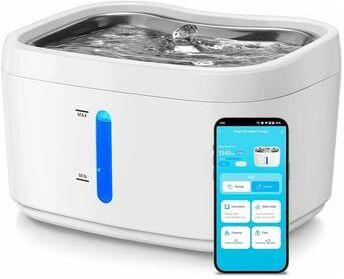
Inspire Essentials Smart App Connected Cat Water Fountain bGive your pet constant access to fresh, flowing water with a smart fountain designed for modern pet care. This automatic water fountain encourages healthy hydration by providing a continuous stream of filtered water that cats and dogs naturally...121,98 $*Shipping: 0,00 $Secure redirect to the provider
-
What is the iterative approximation algorithm for Pi in Java?
The iterative approximation algorithm for Pi in Java is a method that uses a mathematical formula to calculate the value of Pi. One common approach is the Leibniz formula, which uses an infinite series to approximate Pi. The algorithm repeatedly calculates the sum of the series with increasing terms to improve the accuracy of the approximation. This process continues until the desired level of precision is achieved. The algorithm can be implemented in Java using a loop to iterate through the series and update the approximation of Pi with each iteration. **
-
What is the advantage of recursive loops compared to iterative loops in Java or generally in programming?
Recursive loops offer a more elegant and concise solution to problems that involve repetitive tasks. They allow for a more natural way of thinking about the problem, as the function calls itself to solve smaller instances of the same problem. Additionally, recursive loops can handle complex problems that may be difficult to solve using iterative loops, as they can break down the problem into smaller, more manageable subproblems. However, it is important to note that recursive loops may consume more memory and be less efficient compared to iterative loops in some cases. **
-
What is the advantage of recursive loops compared to iterative loops in Java or in programming in general?
One advantage of recursive loops compared to iterative loops is that they can often lead to more concise and readable code. Recursive loops can simplify the logic of the program by breaking down a complex problem into smaller, more manageable parts. Additionally, recursive loops can be more flexible and powerful, allowing for more dynamic and adaptable solutions to problems that may be difficult to solve with iterative loops. **
-
What is the difference between recursive and iterative programming? Aren't they the same? How can I distinguish between them?
Recursive programming involves a function calling itself until a base case is reached, while iterative programming involves using loops to repeat a set of instructions until a condition is met. They are not the same because recursive functions call themselves, creating new instances of the function, while iterative functions use loops to repeatedly execute a block of code. To distinguish between them, look for the presence of function calls within the function itself - if a function calls itself, it is likely recursive. If the function uses loops to repeat a block of code, it is likely iterative. **
* All prices are inclusive of VAT and, if applicable, plus shipping costs. The offer information is based on the details provided by the respective shop and is updated through automated processes. Real-time updates do not occur, so deviations can occur in individual cases. ** Note: Parts of this content were created by AI.